A yarn with Elder and artist – Aunty Jo

June 21, 2023

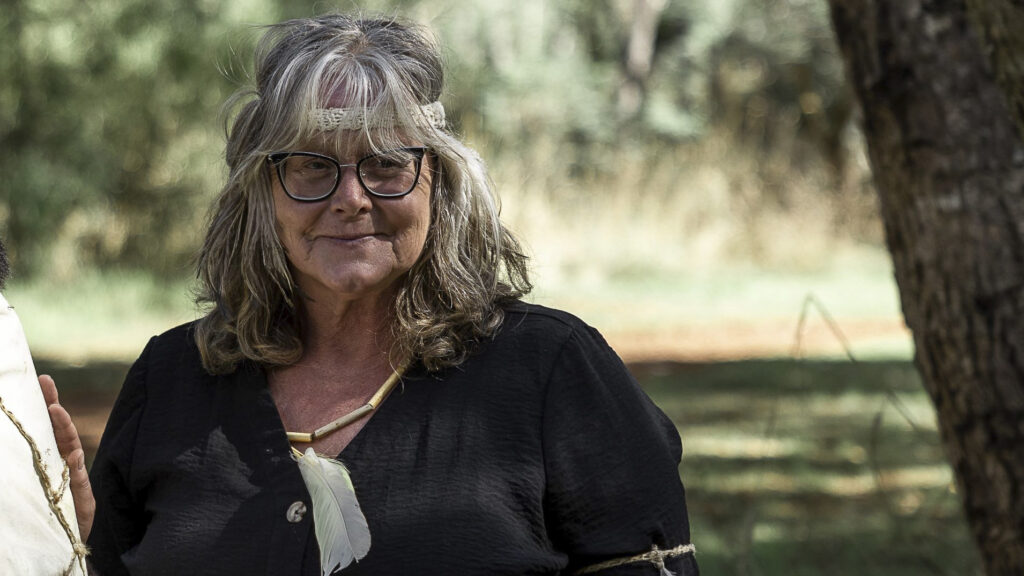
Aunty Joanne Honeysett is a proud Taungurung Elder, wawa biik Cultural Tour Guide, mother, recent grandmother and is also an accomplished artist. Having worked in challenging community roles in the past, her love of painting provided a therapeutic outlet. With an urge to share her Taungurung identity and story, her paintings have become an important part of of her cultural expression. Her work has been commissioned for public murals and sold internationally but she also keeps a tightly-held private collection that is sacred to her and her kids. We yarn about her personal art journey, her art style and future aspirations for the Taungurung artist community.

Tell us about your art style?

Contemporary and traditional experiment with lots of bright colours as well as more earthy colours. I go with how I feel on the day and my style may change depending on what is going on in my life, but there’s always a story with my work.

Why do you paint?

I’ve always worked in the community in pretty challenging roles like child protection and drug and alcohol, so painting is my way to de-stress and balance everything out in my life. I feel the need to create. I think culturally, it is in us to paint. I find it immensely satisfying. When I was younger, I was told that I can’t paint and that I was useless. It wasn’t until I had a friend buy one of my paintings that I started to get my confidence up and feel my art was of value. I’ve never looked back since that first painting sold. I don’t paint to sell works though, I paint because it is a passion and I have this urge to share a part of myself, my story, my culture.

Who or what inspires your art practice?

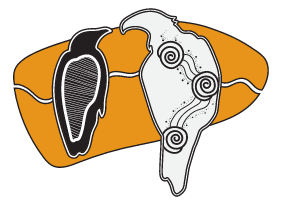
My family, My Country, My Culture. I paint what I feel. I can never have anyone tell me what to paint. They can commission my work but can’t direct me what to paint. I do have some precious paintings that I’ll never sell because they are too sacred to me. One particular painting that I did of my sisters, who have now passed away, is one that I look at every day. My son has made me promise that I’ll never sell it, he’s got his eyes on it - but he won’t be getting it until I’m gone! My art features cultural symbols such as our moieties Bundjil and Waa. I also admire the work of Ray Thomas a GunaiKurnai artist who does amazing painting and murals, but I'm also inspired by emerging Taungurung artists. I want to do what I can to help them grow confidence in their expression and know what their art is worth and how to copyright it.

How did you learn to paint?

I’m completely self-taught. I was working at a shoe factory in Collingwood and I’ll never forget the first time I walked into a new art shop that opened on Smith Street. I walked in there and was in awe at everything in there, the textures, the colours, everything. I walked out with four tubes of paint and a canvas, and my love of painting was born. When I first started out, I had a thing with painting rocks, river rocks mainly, they fascinated me. Now I paint lots of different subjects and do lots of different art jobs including logos and posters for organisations.

What materials do you use to paint?

I use mainly acrylics or gauche on canvas, I don’t like oils. I also paint murals, clapsticks and emu eggs. I do enjoy using traditional materials such as ochre, and stringybark – these materials are great for getting different tonal ranges. I didn’t use ochre in the past but I find it has more meaning for me now that I know more about its significance culturally.

Tell us about where some of your work has been displayed?

Back in the 1990s, I had a local newspaper commission an art piece for Reconciliation week. From this opportunity, I was offered a stall in the Pipeworks Market in Campbellfield to sell my art for 12 months. Well, I ended up there for 5 years, my one stall turned into 6 stalls and it was a full-time retail space, where I would be juggling my kids with selling my art. I gave that up, but I do still love to do commissions and sell my work. I recently created a large painting for the Puckapunyal school reception area. I also designed the art for the breast screen shawls as part of the Beautiful Shawls Project and I’ve sold my work to people all around the world. I remember one Irish guy who bought several of my paintings because he loved them – they’re now hanging somewhere in Ireland!

What are some things people may not know about Aboriginal art in Victoria?

Victorian Aboriginal art is a little bit different to that of Northern Territory. The Northern Territory is known for their dot painting, whereas in Victoria our style is more lines and cross hatch and symbols. I do dot paintings too though. It is important to know what symbols we can and can’t use though as there are symbols that can only be used up there, and some symbols that are for men’s business, so we need to be respectful of this when creating our art here in Victoria.

Any final words on Taungurung art in general?

We have lots of great Taungurung artists including great weavers, carvers, painters, photographers, some are established and others are emerging. It’s been our dream to have our own Cultural Centre where we can showcase and sell our work. I’d love to see this happen. I’m passionate about making sure our young artists are supported so that their work is valued and protected. We are looking at ways that we support them with workshops and opportunities – this excites me.

Ngun Godjin to Melbourne Water staff, who joined us on the wawa Nagambie tour today. As part of the tour we joined in the Aussie Bird Count — Australia’s biggest citizen-science event! We took a moment to slow down, listen, and notice the incredible birdlife that thrives around Tahbilk’s billabongs — a haven for native species. 
Each sighting reminds us how caring for Country begins with paying attention. 

#AussieBirdCount #WawaBiik #Nagambie #TaungurungCountry #CaringForCountry #BirdlifeAustralia #Tahbilk
Birdlife Australia runs an annual Aussie Bird Count to inspire everyone to take notice of our little feathered friends and get familiar with bird movements. As they say, noticing birds is the first step towards caring about them – and where conservation begins. 

Today on our wetlands cruise at Tahbilk we took the opportunity to participate in the bird count – Australia’s biggest citizen-science event. 

Over 100 species of native birds have been recorded at Tahbilk and during our cruise we spotted: 

Australian Pelicans x 6
Black swans x 5
Azure Kingfisher x 2
Cormorants x 8
Dusky Moorhens x 4 
Australian Magpies x 4
Scarlet robin x 2
Australian Ravens x 2

Tahbilk are committed to nurturing this remarkable environment. Together with the Goulburn Broken Catchment Management Authority, they’ve invested in long-term habitat restoration—from planting native vegetation to fencing out livestock and controlling invasive weeds.

They’ve also installed nesting boxes for wildlife and are managing pest species like foxes and rabbits to give native fauna the best chance to flourish.

Observing life around these billabongs always presents something new and exciting. 

#taungurungcountry #visit_tahbilk #goulburnregiontourism #birdlifeoz #billabongs #culturaltours #birdsofaustralia
This website and any content on this website are protected by the Copyright Act 1968 (Cth), and may also contain Indigenous Cultural and Intellectual Property (ICIP). All rights are reserved.
You may only deal with the content of this website with the prior written consent of TLaWC, the copyright owner and/or the Traditional Custodians of that ICIP, and with attribution. Contact communications@tlawc.com.au for enquiries about permitted reproductions. Visitors who book cultural experiences through this website must comply with the wawa biik Standard Booking Conditions, available here.