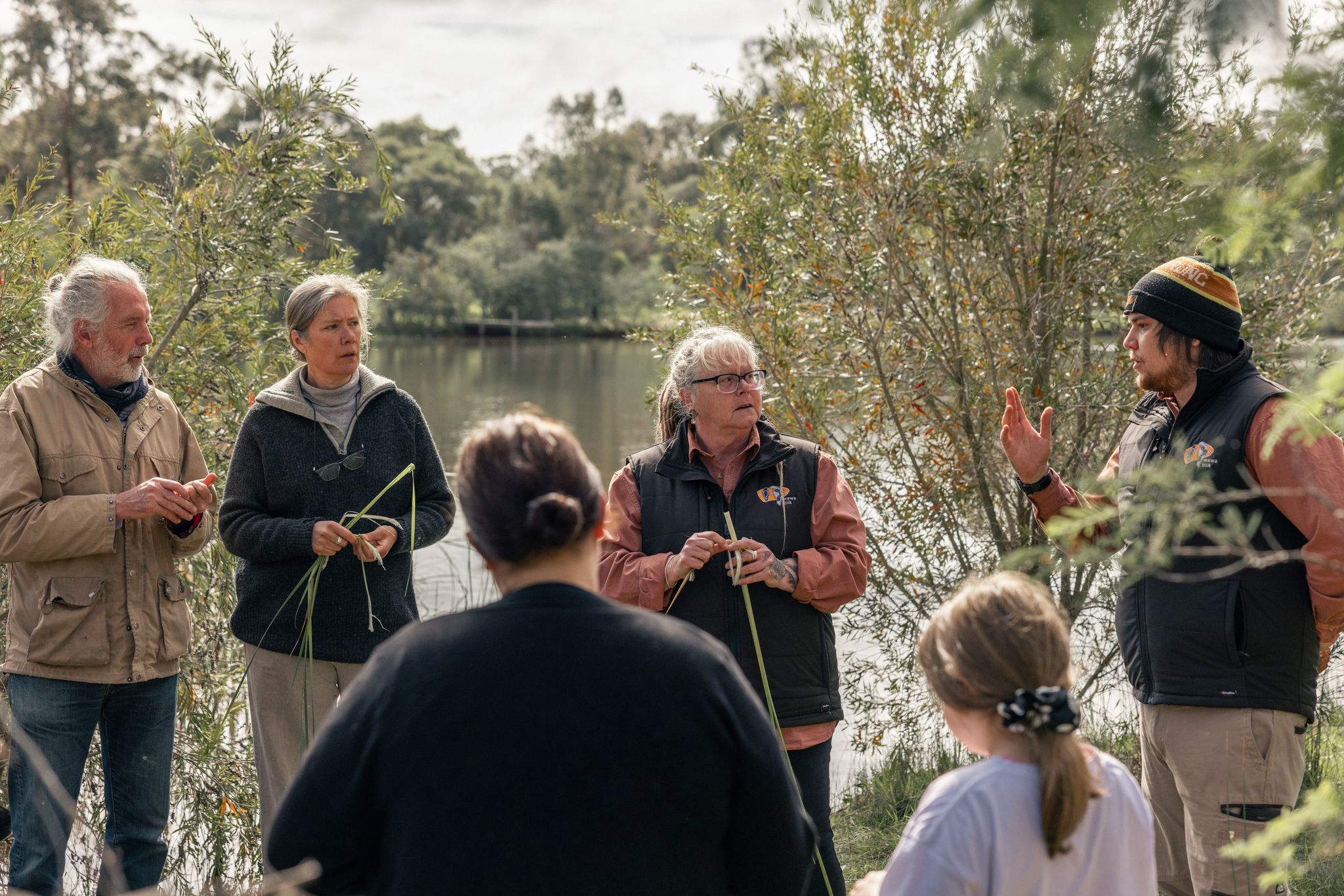
What an adventure! The wawa biik team delves into the highlights of our first year of operation.

February 2024 marks our wawa biik one year anniversary. One year on and we’ve been having a laugh about all the funny moments; thinking back to all the great yarns with our friendly guests and reflecting on the honour of being out on Country doing what we love. It’s no secret that running a successful tourism business is hard work at times and we have overcome some challenges in the past year. But our resilience shines through and we stay focused on the positives of what wawa biik has achieved and will continue to achieve for the Taungurung Nation.  Our team reveals all…..

Behind the scenes of wawa biik – a yarn with Sharna

Sharna Crosbie is the Cultural Experiences Development Manager at wawa biik. Sharna is not a First Nations person but feels honoured to work alongside the Taungurung community in her role.  With an extensive career in tourism development and marketing, Sharna has led the small but deadly wawa biik team, through what has been a slow and considered start-up journey to bring wawa biik to life.  We yarn with Sharna about her learnings and the importance of First Nations tourism.

What is yarning?

If you’ve been on a wawa biik experience, you would have had plenty of yarns. Yarning is more than a conversation or a story – it’s a deeply cultural way of learning, sharing and connecting. For thousands of generations the tradition of yarning has been practiced by our Taungurung Ancestors and First Nations Peoples across Australia. Today it is a big part of our culture– in sharing knowledge, story, experience, and building relationships.

Yarning is a way of connecting and purposefully sharing knowledge through narrative. It can include anecdotes, stories and experiences, plus if you’ve met any of our wawa biik guides – a good laugh. Yarns are typically non-linear and free flowing – so that means that topics and themes may seemingly go off on tangents, but these themes are often revisited, allowing for connections and learnings to surface as different parts of the yarn come together.

Yarning is just as much about sharing knowledge as it is for building strong relationships. Cultural protocols create a safe space for yarning between people – ‘active listening, mutual respect and building on what others have said rather than openly contradicting them’ (Yunkaporta 2019, 131) is incredibly important, enabling the flow to respect different points of view.

Aunt Jo on the importance of yarning on tour:

Our wawa biik experiences are built on dhumbak gadhaba (yarning together). We create a safe space for everyone to share and be part of the conversation. We acknowledge that we are all coming to biik (Country) from different places, experiences, understanding and knowledge and that’s ok. Our yarns are about sharing our culture, story and experience but this can only happen when we are there respecting each other, listening to each other, and to biik, our Country, so that we can walk together.

To keep learning about yarning see:

Atkinson, P, Baird, M & Adams, K 2021, ‘Are you really using Yarning research? Mapping Social and Family Yarning to Strengthen Yarning research quality’, AlterNative, 17 (2), 191 – 201.

Yunkaporta, T, 2019, Sand Talk: How Indigenous Thinking Can Save the World, The Text Publishing Company, Melbourne Australia
Communicating in ways that words cannot – a yarn with Hunter Callaghan

Take a closer look at the beautiful images on the wawa biik website, and below. You may notice they communicate not only the warmth and excitement of the wawa biik journey, but also hint at the pride and connection that the photographer Hunter Callaghan has to his mob and Country. Hunter belongs to the Nira-illim Bulluk Clan of the Taungurung Nation and was born and raised in the western suburbs of Naarm, Bunurong Country. He works as a content producer for RMIT University but is also a freelance photographer driven to capture the faces and places that tell the Taungurung story.

In 2020, Hunter created a powerful photo–documentary book titled UNEARTHED. The black and white images are a stark reminder of a duality that exists between the proud and enduring culture created by Taungurung Ancestors, contrasted with the heavy impact of colonisation and the painstaking daily work needed to protect Taungurung cultural heritage for the future. Hunter’s images provoke empathy and understanding of cultural complexities but are also his personal way of deepening his own cultural knowledge and connections.

All the ingredients for a strong partnership – a yarn with our caterer

Debbie’s melt in your mouth lemon myrtle cookies have become a much-loved staple of our wawa Euroa experience.  Debbie Redding of Debbie’s Delights has been baking delicious food for over 37 years but more recently has enjoyed learning and experimenting with Indigenous ingredients, including our delicious wawa biik morning teas. Deb grew up on Wurundjeri Land but has raised her family in the tranquil town of Yea, Taungurung Country. Her and her family love sitting around the fire, feasting under the stars, swimming in the river and watching the seasons change. As a small business owner living and working on Taungurung Country, taking part in the wawa biik partnership program has given Deb the opportunity to connect with Taungurung Elders and deepen her connection to the land. Deb’s philosophy is all about sharing good food, laughter and quality time on Country with family and friends – we are delighted to have Deb as part of our extended team.

Our youth rise to the occasion

After months of preparations and rehearsals, the day had arrived. It was Friday 4th of August on National Aboriginal and Torres Strait Islander Children’s Day and the scene was set for what would be a momentous and proud day for the Taungurung Nation. It was the launch of Wayilak Bayubarring (Taungurung’s inaugural Youth Advisory Group) and they were set to revive a traditional dance that had not been performed for 15 years.

Sand had been shipped in to form a dance circle, hand-made intricate adornments were worn and Elders shed proud tears as they painted up the group with ochre.  As the crowd arrived and the nerves took hold for the group, the rains came…. but that didn’t stop them. Up went the umbrellas and the show went on.

Aunty Joanne Honeysett provided the Welcome Smoking Ceremony and Bobbie Pepper introduced the members of the group and then, queue the music and out they came.  Time seemed to stand still as they performed the Emu, the Swan and the men did the Bundjil. Aunty Joanne said, “Three Waa’s (the Crow – one of the Taungurung moieties) were spotted watching the youth as they reawakened our traditional dance.” It didn’t matter where you looked – everyone was overcome with emotion, filled with pride, awe and tears of joy.

Bobbie, who heads up Wayilak Bayubarring is keen to see the positive momentum of this group continue and issued a call to action for everyone in attendance: “When you have unwavering commitment and support you are unstoppable, so I ask you all to think how you can support this youth advisory group. For our mob here today, it is an invitation and a demonstration that they are ready for your cultural knowledge and open to anything you would like to offer. For everyone else it is a warm welcome into our space and to get to know every member of Wayilak Bayubarring and listen and share in collaboration.”

After the event, the youth members reflected and spoke of their love and respect for each other and their Connection to Country getting stronger through the activities of this advisory group which also strengthens their wellbeing and identity.

Final words from Bobbie on the day sum up what everyone in attendance felt: “You are brave, you are courageous, and you are just bloody deadly.”

Home Ground Advantage – a yarn with Bonnie

Bonnie Welch (nee’ Cavanagh) is a proud Taungurung woman, descendant of John Franklin, self-confessed sports tragic and the kind of deadly person you always want on your team. Growing up, Bonnie set her sights on being either a physio for the Geelong Football Club or a Forensic Investigator. She opted for the path less travelled and completed her criminal justice degree, going on to contribute fourteen years with the Victorian Police in the State Forensics Services Centre in Macleod – despite being told there was no way she’d get a job in Forensics. But she didn’t give up on her sporting ambitions either, she is still a mad Geelong supporter and has been involved – both on and off the ground, with her beloved Broadford Football/Netball Club for twenty years. Bonnie’s passion and determination is now focused on her family and her mob. As Mum to beautiful two-year old daughter Georgia Reign and as the Executive Manager of the Community and Culture division of the Taungurung Land and Waters Council and guide for wawa biik, her future ambition is clear and her drive is even more tenacious.

A yarn with Elder and artist – Aunty Jo

Aunty Joanne Honeysett is a proud Taungurung Elder, wawa biik Cultural Tour Guide, mother, recent grandmother and is also an accomplished artist. Having worked in challenging community roles in the past, her love of painting provided a therapeutic outlet. With an urge to share her Taungurung identity and story, her paintings have become an important part of of her cultural expression. Her work has been commissioned for public murals and sold internationally but she also keeps a tightly-held private collection that is sacred to her and her kids. We yarn about her personal art journey, her art style and future aspirations for the Taungurung artist community.

The back story of ”We Scar Many Trees” with the artist, Uncle Mick Harding

Uncle Mick is a proud Taungurung Elder of the Yowong-Illam-Baluk and Nattarak Baluk clans of the Taungurung Nation and takes pride in sharing cultural narratives through his work. He describes art as a ‘rainbow of many things’, which is fitting for someone that specialises in many different mediums including wood working, sculpture, and printmaking.  He has his own family art business called Ngarga Warendj (Dancing Wombat) producing beautiful hand-made cultural items and gifts.

He likes to push the boundaries with his art practice. His most recent project called ‘We Scar Many Trees’ took an innovative approach by taking an age-old cultural practice of scarring trees and presenting it as a contemporary art form. Working alongside his sons Mitchil and Corey they expressed cultural stories within the scarred trees across the entire length of the Great Victorian Rail Trail. Uncle Mick cites this project as one of his most proud because of the opportunity to pass on cultural knowledge to his sons as part of the process.

We yarn with Uncle Mick to delve into his unique art story and find out more about his works on the recently launched Art on the Great Victorian Rail Trail.

A closer look at the Yea Wetlands Discovery Centre

The Yea Wetlands Discovery Centre, in the heart of Taungurung Country is not only an accredited Visitor Information Centre but is also a multi-faceted learning experience on the importance of water resources and wetland ecology. It features interpretive displays, a gift shop, room hire and local information inside but the main drawcard is what is to be found outside. They have 32 hectares of wetlands and walking trails on their back doorstep offering recreational and educational opportunities in this unique habitat.

With strong family ties to the Yea area, Aunty Angela ten Buuren (Franklin), along with her family members have been heavily involved in the wetlands committee over many years. They are passionate about sharing the Taungurung story of this place and embedding Taungurung perspectives and culture into both the visitor experience and management of this important ecosystem on Country.

We yarn with Aunty Angela about the Taungurung aspects that visitors can engage with at the Yea Wetlands Discovery Centre precinct, including the Franklin Trail, Taungurung art, Indigenous Garden, and new Taungurung art on display.